
In brief
The AI Act, EN 18286 and ISO/IEC 42001 do three different jobs. Most of the confusion we see comes from treating them as substitutes for one another.
- The AI Act is the law. It imposes binding obligations on operators according to their role and the risk category of the system or model.1
- EN 18286 is the legal bridge for one obligation. It is the only standard cited in the Official Journal under the Act, and it gives a presumption of conformity for the quality management system (QMS) that Article 17 requires of high-risk providers.23
- ISO/IEC 42001 is the organisational operating system. It is a voluntary, certifiable international standard for an AI management system (AIMS), open to any organisation that supplies or uses AI. It gives no presumption of conformity under the Act.14
- They are designed to stack. The Commission describes EN 18286 as layered on top of ISO/IEC 42001, ISO 9001 or a sectoral QMS, and EN 18286 contains a clause map to EN ISO/IEC 42001.23
The first post in this series explained how EN 18286 came to be cited. This one maps how the three fit together. The third sets out what a Chief Compliance Officer should do about it.
Three different kinds of instrument
The relationship is clearest if you ask three questions of each instrument: who made it, who must follow it, and what following it gets you.
| AI Act | EN 18286:2026 | ISO/IEC 42001:2023 | |
|---|---|---|---|
| Nature | EU regulation, directly applicable | European standard, cited as harmonised | International management system standard |
| Author | EU legislator; amended by Regulation (EU) 2026/1744 | CEN-CENELEC JTC 21, on Commission request | ISO/IEC JTC 1/SC 42 |
| Binding? | Yes | No, voluntary | No, voluntary |
| Addressees | Operators by role: providers, deployers, importers, distributors, authorised representatives, product manufacturers | Providers of AI systems, primarily high-risk | Any organisation that supplies or uses AI systems |
| Unit of analysis | The AI system or general-purpose AI model, by risk category | Each AI system's lifecycle, within one QMS | The organisation, within the AIMS scope it sets |
| What compliance gets you | Lawful market access | Presumption of conformity with Art. 17(1) and the first sentence of Art. 11(1) | A certifiable AIMS; no presumption under the Act |
| Who checks it | National market surveillance authorities and, for some matters, the AI Office | The provider (Annex VI) or a notified body (Annex VII), when assessing the QMS | Accredited certification bodies, if certification is sought |
The European adoption of ISO/IEC 42001 trips people up. CEN has adopted it without change as EN ISO/IEC 42001:2026, and national standards bodies now sell it under that designation, listing no linked directive or regulation.6 The "EN" prefix signals European adoption, not legal effect. ISO/IEC 42001 was not drafted under the AI Act request and is not cited in the Official Journal, so it confers no presumption of conformity.1
ISO/IEC 42001 in brief
ISO/IEC 42001 was published in December 2023 by ISO/IEC JTC 1/SC 42 as a management system standard for AI, against which organisations can seek third-party certification.74 It applies to any organisation, of any size, that provides or uses products or services that use AI systems.6
- Structure. Clauses 4 to 10 follow the harmonised structure shared with ISO 9001 and ISO/IEC 27001, which makes integration with existing management systems straightforward.17
- Risk and impact. The organisation must run an AI risk assessment, AI risk treatment, and an AI system impact assessment covering effects on individuals, groups and society (clauses 6.1.2 to 6.1.4).1
- Controls. Annex A lists 38 reference controls across nine areas, from AI policy and internal organisation to data, information for interested parties, and third-party relationships. Not every control is mandatory: the organisation selects them through risk treatment and justifies inclusions and exclusions in a statement of applicability.74
- Certification. Third-party certification is optional. Certification bodies work to ISO/IEC 42006:2025, which adds AI-specific requirements to ISO/IEC 17021-1, and certification typically runs on a three-year cycle with annual surveillance audits.4
- Roles. The organisation determines its own roles, such as AI provider, producer or customer. These are not the operator roles of the AI Act, and an organisation's role under the Act is fixed by the Act, not by its ISO scoping.4
Its strength is breadth. It reaches every AI system in scope, not only high-risk ones, and it suits deployers as naturally as developers. Its limitation for AI Act purposes is the reverse side of that flexibility: it is a framework the organisation tailors to its own objectives.8 That is exactly what a harmonised standard cannot be.
EN 18286 and ISO/IEC 42001 compared
Both are management system standards, and both deal with risk, documentation, competence and review. They answer different questions. ISO/IEC 42001 asks whether the organisation is managing AI responsibly in pursuit of its objectives. EN 18286 asks whether each high-risk system the provider places on the market complies with the law.13
| Dimension | EN 18286:2026 | ISO/IEC 42001:2023 |
|---|---|---|
| What success means | Compliance with the AI Act and the law protecting health, safety and fundamental rights; expressly distinguished from the customer-focused ISO 9001 notion of quality | Meeting the organisation's AI objectives and the requirements of interested parties |
| Definition of risk | Probability of harm combined with its severity, where harm covers injury to health and interference with fundamental rights, as in Article 3(2) of the Act | "Effect of uncertainty", positive or negative; the organisation may adopt a sector definition such as ISO/IEC Guide 51 |
| What counts as a requirement | Stated or obligatory needs | Stated, generally implied or obligatory needs |
| Organising unit | The AI systems within the QMS scope and their lifecycle | The organisation's AIMS, in a scope it chooses |
| Name for a failure | Non-compliance with a regulatory requirement | Nonconformity with any requirement |
| Internal audit | No requirement; audit results are a recommended management review input | Audit programme required (clause 9.2) |
| Continual improvement | No clause; improvement through management review and change planning | Required (clause 10.1) |
| Regulatory procedures | Compliance strategy, technical documentation, post-market monitoring, serious incident reporting within fixed time limits, non-compliance handling, communication with authorities | The organisation determines its own reporting obligations; no time limits or named authorities (Annex B guidance) |
| Impact assessment | No AI system impact assessment; consultation with affected persons recommended (Annex A) | AI system impact assessment required (clause 6.1.4) |
| Controls catalogue | None; requirements are written as obligations | 38 reference controls in Annex A, selected through risk treatment |
| Legal effect under the Act | Presumption of conformity for Art. 17(1) and the first sentence of Art. 11(1), on Annex ZA's conditions | None |
The first two rows carry most of the weight. A risk that is tolerable for the business may not be acceptable under the Act, and a QMS optimised for organisational objectives can reach decisions a regulator would not accept.910 EN 18286 closes that door by defining quality as compliance and risk as harm to people. ISO/IEC 42001 leaves the choice open, deliberately: it lets each organisation adopt the concept of risk that fits its sector, including the product-safety one.37
Why ISO/IEC 42001 was not simply harmonised
The obvious question is why Europe did not cite ISO/IEC 42001 and spare everyone a new standard. EU policy is "international first": international standards that fit EU requirements can become harmonised standards.11 The Commission's view, set out by its Joint Research Centre in 2024, was that the fit was not there. AI Act standards must prioritise risks to individuals' health, safety and fundamental rights, and must complement the organisation-centric view of existing international standards with a focus on AI systems and products.9
Practitioners close to the drafting have put the objection more bluntly. A harmonised standard cannot leave the organisation free to make arbitrary choices; every requirement must be written against the legal text. References to customer needs and organisational objectives cannot be allowed to steer a regulatory QMS. And the ISO notion of risk sits uneasily with the product-safety notion the Act uses.3710 Medical devices went through the same exercise a generation ago, which is why ISO 13485 exists alongside ISO 9001.10
Equally, the Act demands things ISO/IEC 42001 never set out to cover: EU declarations of conformity, CE marking, reporting to and cooperation with authorities, and the outright prohibitions in Article 5.8
That does not leave ISO/IEC 42001 on the sidelines. Three bridges connect it to the Act.
- Annex C of EN 18286 maps EN 18286 clauses to EN ISO/IEC 42001:2026 clauses. It maps clauses, not requirements or concepts: it tells you where to look, not what you already satisfy. By that table's own account, EN 18286's strategy for regulatory compliance and its entire operations clause, covering post-market monitoring, incidents, supply chain and modifications, have no counterpart among ISO/IEC 42001's clauses, although some of ISO/IEC 42001's Annex A controls touch the same ground.37
- EN 18286 borrows where the fit is good. Its provision on reporting concerns adapts ISO/IEC 42001's guidance on the same subject, its quality objectives clause is a modified version of ISO/IEC 42001's objectives clause, and its record-keeping on non-compliance draws on ISO/IEC 42001's corrective action clause.3
- ISO/IEC 42001 outputs can feed AI Act duties. Its risk and impact assessments can be inputs to an Article 9 risk management system or an Article 27 fundamental rights impact assessment. They replace neither.1
The overlap is also uneven by layer. One governance-software provider's control mapping found that EN 18286 shares more controls with ISO/IEC 42001 at organisation level, and more with the AI Act itself at AI-system level.1 That matches the design intent: ISO/IEC 42001 is strongest on organisational scaffolding, EN 18286 on what happens to each regulated system.
The wider family around EN 18286
EN 18286 is the first member of a family. The Commission's request covers ten areas, and CEN-CENELEC describes EN 18286 as one of the first building blocks of a landscape that will extend to risk management, cybersecurity, logging and more.1112 EN 18286 is built to sit at the centre. Its compliance-strategy clause asks the provider to identify each applicable requirement and choose how to meet it: through cited harmonised standards, adopted common specifications, or other standards and specifications.3 As each Section 2 standard is cited, it slots into that strategy and brings its own presumption under Article 40.13
How the three instruments stack, as at 30 October 2026
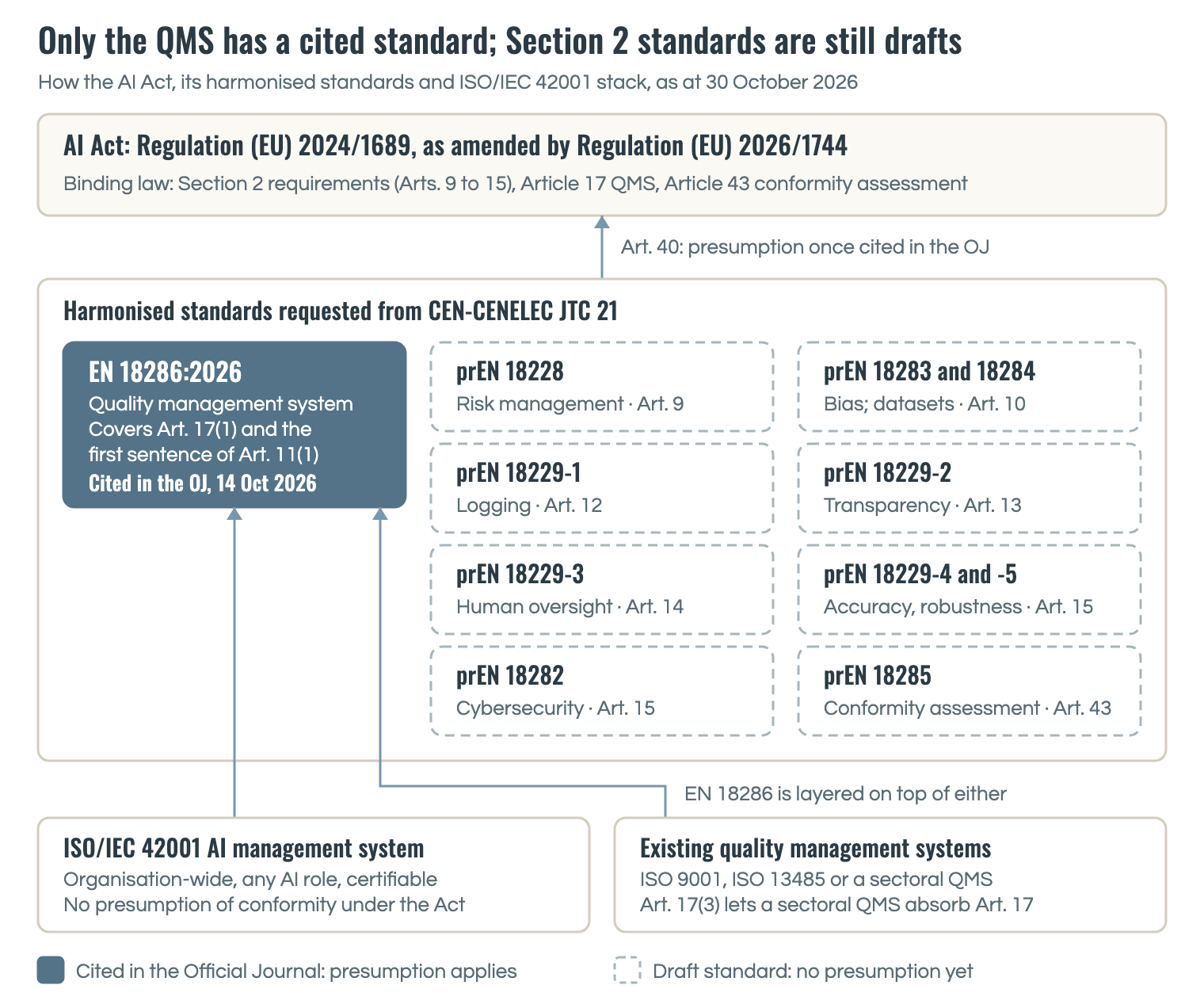
| Layer | Instrument | What it covers | Status |
|---|---|---|---|
| Law | AI Act: Regulation (EU) 2024/1689, as amended by Regulation (EU) 2026/1744 | Section 2 requirements (Arts. 9 to 15), Article 17 QMS, Article 43 conformity assessment | Binding |
| Harmonised standard | EN 18286:2026, quality management system | Art. 17(1) and the first sentence of Art. 11(1) | Cited in the OJ on 14 October 2026; presumption of conformity applies under Art. 40 |
| Draft harmonised standard | prEN 18228 | Risk management (Art. 9) | Draft; no presumption yet |
| Draft harmonised standard | prEN 18283 and prEN 18284 | Bias; datasets (Art. 10) | Draft; no presumption yet |
| Draft harmonised standard | prEN 18229-1 | Logging (Art. 12) | Draft; no presumption yet |
| Draft harmonised standard | prEN 18229-2 | Transparency (Art. 13) | Draft; no presumption yet |
| Draft harmonised standard | prEN 18229-3 | Human oversight (Art. 14) | Draft; no presumption yet |
| Draft harmonised standard | prEN 18229-4 and -5 | Accuracy, robustness (Art. 15) | Draft; no presumption yet |
| Draft harmonised standard | prEN 18282 | Cybersecurity (Art. 15) | Draft; no presumption yet |
| Draft harmonised standard | prEN 18285 | Conformity assessment (Art. 43) | Draft; no presumption yet |
| Organisational foundation | ISO/IEC 42001 AI management system | Organisation-wide, any AI role, certifiable | Voluntary; no presumption of conformity under the Act; EN 18286 can be layered on top |
| Organisational foundation | Existing quality management systems: ISO 9001, ISO 13485 or a sectoral QMS | Art. 17(3) lets a sectoral QMS absorb the Article 17 aspects | Voluntary; EN 18286 can be layered on top |
Only EN 18286 carries a presumption today. The drafts beneath it are at different stages, and three of them (risk management, cybersecurity and logging) were voted down at public enquiry in summer 2026.14 ISO/IEC 42001 and existing quality systems sit underneath, as the organisational foundation on which EN 18286 is layered.
One system, three layers
For most organisations the right answer is not to choose among the three, but to build one management system that serves all of them.
- Organisational layer: ISO/IEC 42001. Use it for AI policy, roles, competence, the AI inventory, risk and impact assessment across all AI systems, supplier management and internal audit. It covers the AI you buy and deploy as well as the AI you build, supplies the internal audit programme that EN 18286 does not itself require, and gives customers a certifiable signal.374
- Regulatory product layer: EN 18286. For each high-risk system you provide, run the lifecycle, technical documentation, post-market monitoring, serious incident and non-compliance processes EN 18286 requires, traceable to Article 17(1) through Annex ZA.3
- Requirement layer: Articles 9 to 15 of the Act. Until the Section 2 standards are cited, document how each requirement is met. Article 17(1)(e) requires it, and EN 18286's compliance-strategy clause makes you choose, requirement by requirement, among cited standards, common specifications and other specifications, and record the result in the technical documentation.315
Three design rules keep the layers honest.
- Keep the vocabularies apart. Log regulatory non-compliance separately from ISO nonconformities. They trigger different duties, including corrective action and information duties under the Act.3
- Do not let business objectives set regulatory thresholds. Risk acceptance in the AIMS and risk acceptance for an Article 9 system are different decisions, made against different criteria.910
- Map once, evidence once, review twice. A control executed once can evidence ISO/IEC 42001, EN 18286 and the Act, provided each claim is reviewed against its own text.1
Two special cases deserve early attention. Financial institutions subject to EU internal governance rules can meet most of Article 17 through those rules, but must still deliver points (g), (h) and (i), covering risk management, post-market monitoring and incident reporting, and must take harmonised standards into account.15 Manufacturers already running a sectoral QMS, such as ISO 13485 for medical devices, can fold the Article 17 aspects into it under Article 17(3), and EN 18286 expressly supports extending that system rather than building a second one.315
Related reading in this series
- Part 1 — Introducing EN 18286: The AI Act's Quality Management Standard
- Part 3 — AI Act, EN 18286 and ISO/IEC 42001: A Chief Compliance Officer's Agenda
Disclaimer
This article is general information, not legal advice, and does not create a client relationship. It reflects the AI Act as amended by Regulation (EU) 2026/1744 and the standards landscape as at 30 October 2026. Standards in development change status often; check with your national standards body before relying on a status reported here. Statements about EN 18286 and ISO/IEC 42001 have been checked against the texts of EN 18286:2026 and ISO/IEC 42001:2023 and are paraphrased, not reproduced. Both standards are copyrighted documents, available from national standards bodies, and should be read in full before any conformity or certification claim is made.
Notes and sources
Footnotes
-
Modulos, ISO/IEC 42001 vs EU AI Act, updated 23 October 2026. ↩ ↩2 ↩3 ↩4 ↩5 ↩6 ↩7 ↩8 ↩9 ↩10 ↩11
-
European Commission, First harmonised standard supporting the AI Act published in the Official Journal, 19 October 2026. ↩ ↩2 ↩3
-
CEN, EN 18286:2026, Artificial intelligence – Quality management system for EU AI Act regulatory purposes, approved by CEN on 12 July 2026 (available from national standards bodies). ↩ ↩2 ↩3 ↩4 ↩5 ↩6 ↩7 ↩8 ↩9 ↩10 ↩11 ↩12 ↩13 ↩14 ↩15 ↩16
-
Modulos, ISO/IEC 42001:2023 scope, statement of applicability and certification, updated 19 October 2026. ↩ ↩2 ↩3 ↩4 ↩5 ↩6 ↩7
-
spilma, AI Act: EN 18286 is the first harmonised standard cited, updated 16 October 2026. ↩
-
Estonian Centre for Standardisation and Accreditation, EVS-EN ISO/IEC 42001:2026, catalogue entry. ↩ ↩2
-
ISO/IEC, ISO/IEC 42001:2023, Information technology – Artificial intelligence – Management system, first edition, December 2023 (adopted without change as EN ISO/IEC 42001:2026). ↩ ↩2 ↩3 ↩4 ↩5 ↩6 ↩7 ↩8
-
Freshfields, EU AI Act unpacked #10: ISO 42001 – a tool to achieve AI Act compliance?, 11 July 2024. ↩ ↩2
-
Joint Research Centre, Harmonised Standards for the European AI Act, Science for Policy Brief JRC139430, October 2024. ↩ ↩2 ↩3 ↩4
-
A. Leon Smith, Managing the quality of AI: navigating the global regulatory and standards landscape, CQI Quality Live presentation. ↩ ↩2 ↩3 ↩4 ↩5
-
European Commission, Standardisation of the AI Act. ↩ ↩2
-
CEN-CENELEC, EN 18286 in the Spotlight: Supporting Compliance with the AI Act, 31 July 2026. ↩
-
AI Act, Article 40, consolidated text as at 27 July 2026, AI Act Service Desk. ↩ ↩2
-
G. P. Krog, Edition 16 (September 2026): the essence, AI Standardisation Watch, 8 September 2026. ↩ ↩2
-
AI Act, Article 17, consolidated text as at 27 July 2026, AI Act Service Desk. ↩ ↩2 ↩3